Table of Contents
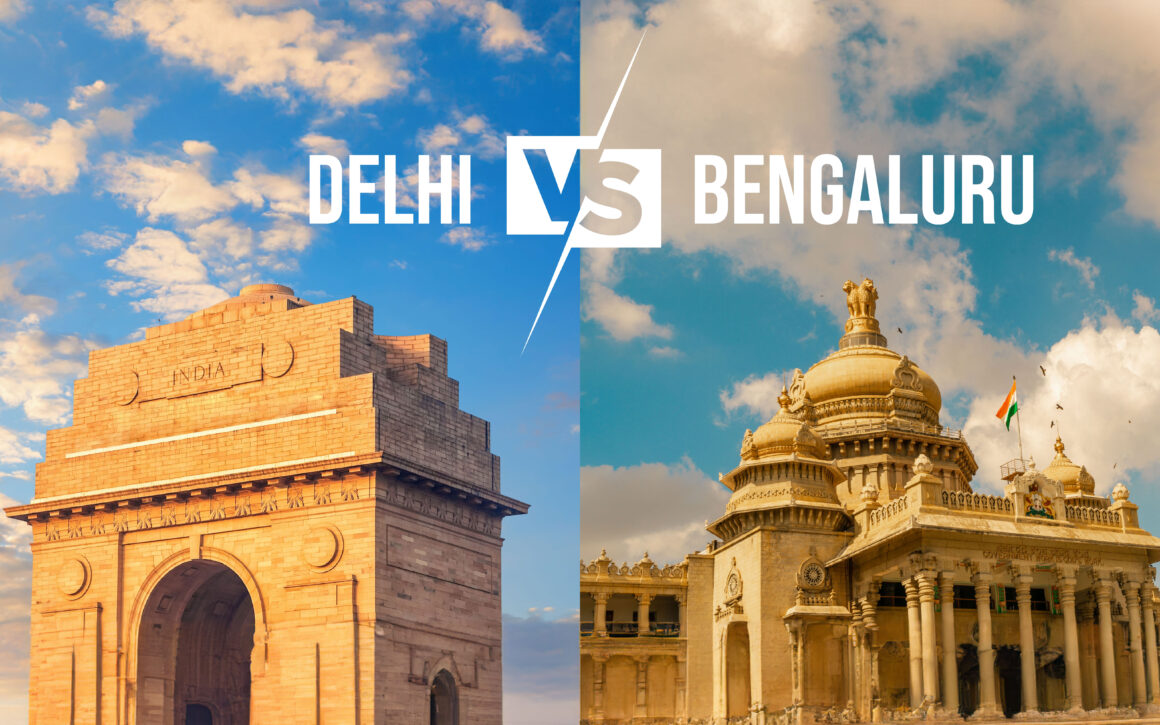
When weighing Bangalore vs Delhi, choosing the right city to live in can significantly impact your quality of life, career prospects, and overall well-being. In India, Bangalore and Delhi emerge as two prominent cities, each with its own distinct charm and challenges. Whether you’re considering relocating for work, education, or lifestyle preferences, understanding the nuances between these two bustling metropolises is crucial.
Bangalore attracts tech enthusiasts and entrepreneurs from around the globe with its vibrant startup culture and pleasant climate. On the other hand, Delhi, the political and cultural capital of India, entices with its rich history, bustling markets, and diverse communities. Both cities offer plenty of opportunities, yet they differ significantly in cost of living, infrastructure, and safety.
1. Cost of Living: Bangalore vs Delhi
When considering the cost of living in both Bangalore and Delhi, housing and daily commutes play the biggest role.
Daily Cost Comparison (2026 Estimates)
| Category / Item | Bangalore Price (₹) | Delhi Price (₹) | Difference (%) |
| Food & Drinks | |||
| Inexpensive Restaurant Meal | 350.00 | 350.00 | 0.0% |
| Mid-range Meal for 2 People | 1,800.00 | 2,000.00 | +11.1% (Delhi higher) |
| Domestic Beer (1 pint) | 240.00 | 220.00 | -8.3% (Bangalore higher) |
| Cappuccino (Regular) | 220.00 | 226.00 | +2.7% (Delhi higher) |
| Daily Markets | |||
| Milk (1 Litre) | 56.00 | 68.00 | +21.4% (Delhi higher) |
| White Rice (1 kg) | 65.00 | 72.00 | +10.7% (Delhi higher) |
| Chicken Fillets (1 kg) | 310.00 | 340.00 | +9.6% (Delhi higher) |
| Potatoes (1 kg) | 35.00 | 30.00 | -14.2% (Bangalore higher) |
| Travel & Bills | |||
| Monthly Public Transport Pass | 1,500.00 | 1,000.00 | -33.3% (Bangalore higher) |
| Taxi / Auto Base Fare | 100.00 | 50.00 | -50.0% (Bangalore higher) |
| Monthly Utilities (915 sq ft flat)* | 2,830.00 | 4,310.00 | +52.3% (Delhi higher) |
| Monthly Rent | |||
| 1 BHK Apartment (City Centre) | 30,160.00 | 23,280.00 | -22.8% (Bangalore higher) |
| 3 BHK Apartment (City Centre) | 72,500.00 | 62,000.00 | -14.4% (Bangalore higher) |
| Take-Home Pay | |||
| Average Monthly Net Salary | 1,43,160.00 | 92,770.00 | -35.2% (Bangalore higher) |
When considering the cost of living in both Bangalore and Delhi, it’s crucial to factor in housing options. Zolostays provides affordable and comfortable co-living spaces in Bangalore & Delhi, making it easier to manage your expenses while enjoying a hassle-free living experience.
Cost of Living in Bangalore:
Bangalore’s heavy startup presence and IT hubs keep real estate demand incredibly high. The cost of living has steadily climbed, especially around major commercial zones.
- Housing: Rents are steep in popular areas like Koramangala, Indiranagar, HSR Layout, and Whitefield. Landlords also ask for 5 to 10 months’ rent as an upfront deposit, which is a big financial hit when you move.
- Transportation: Bangalore’s heavy traffic means app-based cabs and autos cost more. The Namma Metro is growing, but last-mile connectivity is still tough in many IT belts.
- Food and Entertainment: Going out on weekends is pricey due to local liquor taxes and high restaurant covers, though budget options exist if you look away from main high streets.
Cost of Living in Delhi:
Delhi offers a much broader mix of living options that can fit almost any budget.
- Housing: You can find spacious, independent floors across North and West Delhi that are far cheaper than in Bangalore. Plus, security deposits are standard—usually capped at just 2 months’ rent.
- Transportation: The Delhi Metro is the city’s biggest advantage. It links Delhi, Noida, and Gurugram seamlessly, keeping daily commute costs very low.
- Food and Entertainment: Groceries and markets are highly competitive. Delhi’s food scene ranges from very cheap street food to elite fine dining, meaning you control how much you spend.
2. Economic Opportunities
Bangalore: India’s Silicon Valley Bangalore is India’s tech hub, known for its booming IT industry. The city offers abundant job opportunities in software development, engineering, AI, and data analytics. With a vibrant startup culture, robust infrastructure, and access to venture capital, Bangalore is ideal for tech professionals and entrepreneurs seeking career growth and business success.
Delhi: Economic Diversity and Administrative Hub Delhi, the national capital, boasts a diverse economy with opportunities in government, services, manufacturing, and trade. The city is a major center for finance, law, public administration, and media. Its strategic location and connectivity enhance international trade and business collaborations, making Delhi attractive for a wide range of professionals and entrepreneurs.
Comparative Insights Bangalore is perfect for those seeking tech-driven careers and startup opportunities, while Delhi offers a broader range of job prospects across various industries. Choose based on your career aspirations and professional goals to find the best city for your needs.
3. Safety & Security in Bangalore and Delhi
When analysing the bangalore vs Delhi divide, public safety and community policing are critical puzzle pieces for anyone planning a move.
Bangalore
- The Good: Bangalore is widely considered a safe and inclusive environment, especially for solo professionals, college students, and late-night shift workers in the IT sector. The city’s cosmopolitan culture follows a progressive, “live and let live” philosophy where people mostly mind their own business. Night shifts are the norm here, so seeing women commuting safely via verified company transport or ride-sharing apps at 2:00 AM is a common sight. Local neighbourhoods often feel communal, and community policing initiatives add a layer of security.
- The Ugly: While violent crime rates are lower, the city has seen a rise in sophisticated cybercrimes, online rental scams, and digital financial frauds targeting unsuspecting tech professionals. Additionally, isolated pockets near poorly lit, expanding outer tech corridors can feel insecure after dark, requiring standard urban vigilance.
Delhi
The Ugly: Despite heavy policing, public safety remains a persistent concern, particularly for women travelling alone late at night. Street harassment, pickpocketing, and snatching incidents are statistically more prevalent in public spaces compared to Bangalore. The layout of certain sprawling suburban pockets means that once the metro shuts down for the night, navigating the city requires a significantly higher level of alertness, calculated route planning, and strict reliance on verified private transport.
The Good: Delhi has made massive infrastructural strides to tighten city security. The state has installed one of the densest networks of municipal CCTV cameras in the country, alongside heavily increased police PCR van patrolling in commercial zones. The Delhi Metro is also incredibly secure, featuring dedicated coaches for women, CISF security checks at every single station, and well-lit terminal platforms.
4. Infrastructure in Bangalore and Delhi
Evaluating bangalore vs delhi requires looking closely at transit structures—where one wins on roads, the other wins on layout.
Bangalore
The Good: The city’s massive tech parks—like those along the Outer Ring Road, Whitefield, and Electronic City—offer state-of-the-art office spaces and highly modern residential townships tailored for corporate life.
The Ugly: Urban planning has completely buckled under the population boom. Bangalore’s roads are notoriously riddled with potholes and suffer from poor drainage, turning routine monsoon rains into immediate waterlogging crises. Traffic bottlenecks at legendary spots like Silk Board mean a 10 km commute can easily kill two hours of your day.
Delhi
The Good: Delhi features some of the best transit infrastructure in Asia. The Delhi Metro connects Delhi, Noida, and Gurugram seamlessly, meaning you don’t even need to own a car. The roads are exceptionally wide, highly planned, and supported by a massive network of multi-lane flyovers.
The Ugly: The biggest crisis in Delhi is environmental infrastructure. The city battles hazardous air pollution and toxic winter smog spikes that pose a serious health risk. Additionally, while the newer parts of NCR are highly structured, older pockets of Delhi still suffer from intense street congestion and an aging, overloaded drainage system.
5. Weather and Climate
Evaluating the bangalore vs Delhi metric features a clear winner in terms of comfort, though both climates have a chaotic side.
Bangalore (The “Four Seasons in One Day” Phenomena): Bangalore’s weather is its best asset, but it can be highly unpredictable. Locals joke that you can experience all four seasons in a single day. You might wake up to a chilly, foggy morning that feels like winter, transition into a bright, warm summer afternoon, experience an autumn breeze by evening, and end the night caught in a sudden monsoon downpour. While this requires keeping an umbrella handy, it saves you a fortune on electricity bills because heavy air conditioning is never a necessity.
Delhi (The Extreme Environmental Crisis): Delhi operates exclusively in brutal extremes. Summers are severe with temperatures pushing past 45°C, while winters plunge to shivering single digits. However, Delhi’s biggest structural failure is its winter smog crisis. Between November and January, an atmospheric phenomenon known as thermal inversion traps vehicular emissions, construction dust, and regional farm stubble smoke close to the ground like a lid. This results in hazardous, toxic AQI spikes that cause severe respiratory issues, making the city a tough environment for young children and elderly parents.
6. Educational Institutions
When analysing academic landscapes, the choice between bangalore vs Delhi boils down to specialised research networks versus sheer administrative and cultural scale.
Bangalore
- The Good: It acts as India’s premier cradle for advanced scientific research, technology, engineering, and specialised postgraduate education. Institutions like the Indian Institute of Science (IISc), Indian Institute of Management (IIM-B), and National Law School (NLSIU) offer unparalleled industrial integration, giving students direct placement access to tech giants and global venture funds right across the city.
- The Ugly: The academic ecosystem is heavily tilted toward STEM (Science, Technology, Engineering, and Math) and management fields. If you are pursuing a career in classical liberal arts, deep humanities, regional journalism, or fine arts, the options are significantly limited compared to the capital. Furthermore, the student housing market around premium institutions faces the same high rent inflation and deposit demands seen in the tech corridors.
Delhi
The Ugly: The sheer scale of the student population makes the admissions process a brutal, cutthroat numbers game, where cutoffs often hit unrealistic percentiles. Additionally, campus safety has historically been an issue, requiring student communities to maintain heightened vigilance. The heavy winter pollution levels also frequently force schools and university campuses to shut down physical classes and switch to remote online learning for weeks at a time.
The Good: Delhi offers unmatched academic breadth and cultural diversity across its university campuses. The iconic University of Delhi (DU) is famous for its premier commerce and economics colleges, while IIT Delhi, Jawaharlal Nehru University (JNU), and the Faculty of Management Studies (FMS) cater to top-tier technical and social science minds. The student culture is intensely politically active and socially diverse, serving as the ultimate launchpad for careers in civil services (UPSC), public policy, and national media.
7. Tourism and Weekend Getaways
A core part of the bangalore vs Delhi dynamic is what you can do when you log off on Friday evening. One city is a gateway to serene nature, while the other sits at the absolute center of global heritage.
Bangalore
- The Good: Bangalore is the ultimate base camp for nature lovers and road-trippers. Within a 3 to 5-hour drive, you can escape to the lush coffee estates of Coorg and Chikmagalur, go trekking in the Western Ghats, or visit the historic palaces of Mysore. For a quick morning drive, the sunrise at Nandi Hills is a local rite of passage.
- The Ugly: The city itself has very little historical sightseeing. Aside from the stunning Tudor-style Bangalore Palace and the green lungs of Cubbon Park, the city’s internal landmarks are limited. Furthermore, trying to leave the city for a weekend getaway on a Friday evening means battling the same punishing traffic gridlock that plagues daily commuters.
Delhi
- The Good: Delhi is a living museum. You are constantly surrounded by iconic UNESCO World Heritage sites like the Red Fort, Qutub Minar, and Humayun’s Tomb. It is also the starting point of the famous Golden Triangle, putting the Taj Mahal in Agra and the pink palaces of Jaipur just a short drive or premium train ride away. For mountain lovers, overnight buses connect you directly to Himalayan hubs like Himachal Pradesh and Uttarakhand.
- The Ugly: Tourism inside the city can be an overwhelming sensory assault. Popular historical spots like Chandni Chowk and Jama Masjid face intense crowd density, aggressive street hawkers, and chaotic traffic. Additionally, during the peak summer months, outdoor sightseeing becomes physically exhausting due to the extreme heat waves, while the winter smog crisis frequently drops monument visibility down to zero.
Conclusion
Your choice between these two cities comes down to your career domain and lifestyle priorities:
Ultimately, both cities offer unique advantages depending on your career aspirations, lifestyle preferences, and cultural interests. Whether you lean towards Bangalore’s tech-driven environment or Delhi’s cultural richness, each city promises a distinct experience that reflects India’s diversity and dynamism.